Tuesday, December 19, 2006

Fraser revisited

An extended weekend to Fraser Island ended this Sunday. A few months ago we decided to pay Fraser another visit (read about our previous excursion in Danish here) with Rikke.

Day #1: Departure

Majken and I picked-up the biggest Toyota Landcruiser we could rent. We packed our camping gear and made our way to Fraser Island. Unfortunately, we were a bit slow in packing and made a wrong turn on our way to Rainbow Beach, costing us an extra couple of hours driving time. The delay meant we missed the last barge leaving for the island. As a result we spent our first night in Rainbow.

Day #2: Waddy Point

We left early for Inskip Point where the barges depart. Before reaching Inskip we engaged the 4wd and deflated the tyres to gain better traction on the sand.

It is hard to describe the feeling of hitting the beach on Fraser from the barge - it was a mixture of pleasure and anxiety. Pleasure at the prospect of driving on the beautiful beaches, and anxiety of not knowing if the vehicle would stall or instantly get stuck in dunes.
Fraser Island lies just off the east coast of Australia. At 122 km long, it is the largest sand island in the world. Remnants of tall rainforest growing on sand and half the world's perched freshwater dune lakes are found on the island. The combination of shifting sand-dunes, tropical rainforests and lakes makes it an exceptional site and popular tourist attraction.

We made our way to the northern part of the island, making excellent time driving on the hard sand of 75 Mile Beach. 75 Mile Beach is not only a fantastic beach it is also Fraser Island’s superhighway and air strip - cars (4wds) and planes share this piece of sand.

We reached our destination, Waddy Point, around noon and set up camp. We spent the rest of the afternoon on the beach. Swimming in the sea is, contrary to tradional wisdom, not a normal activity on Fraser with it's shark infested waters, but we found a little inlet where the kids could play and bath safely.

Day #3: Champagne Pools and Indian Head

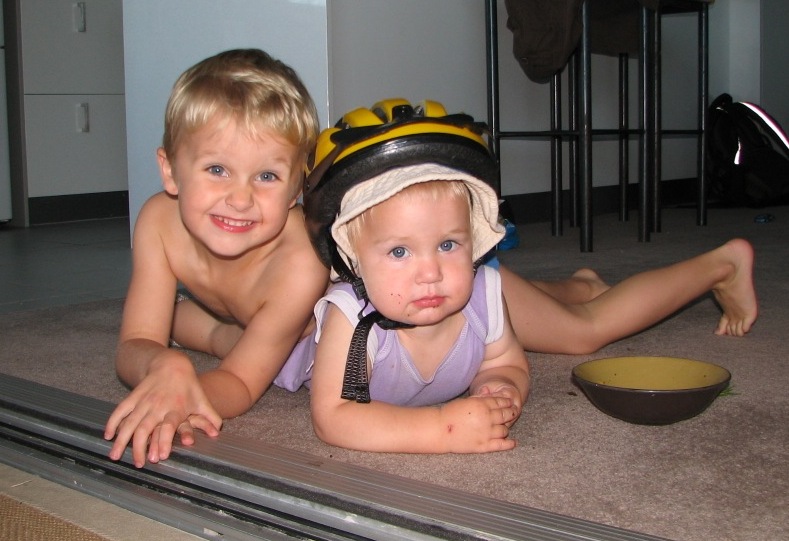
It was a fairly short drive to the Champagne Pools. Here waves from the ocean crash over the rocks, filling the rock pools with white foam giving the impression of champagne. A great place for Tobias and Christoffer to play.

Fraser Island was called K'gari by its Aboriginal inhabitants, it means paradise. The island shows evidence of Aboriginal occupation of least 5000 years, although it is possible that further archaeological work may reveal evidence of earlier occupation. Early European reports indicated that Fraser Island was heavily populated by Aboriginal people, but subsequent research suggests that there was a small permanent population of 400 - 600 which swelled seasonally to perhaps 2,000 - 3,000 in the winter months, when seafood resources were particularly abundant. The last Aborigines - Butchulla tribe - left the island in 1904 when the Aboriginal mission at Bogimbah was closed.

Leaving the Champagne Pools, we headed to Indian Head with a perfect view of the coastland. After some camera snapping including sightings of some dolphins and a Manta Ray we descended to the beach and spent the rest of the day resting and playing in the sand.

Day #4: Central Station

In the morning we packed our belongings and headed south on 75 Mile Beach passing a shipwreck of a luxury liner from the 1930s. It is slowly sinking into the sand. In a couple of decades it is likely be entirely submerged at the current rate of erosion.

Travelling further south we reached the entrance to Lake Wabby. The lake is a short (1.8 km) walk through the rain forest and over rolling sand dunes. The walk, however, didn't feel short in the heat and with Christoffer on my shoulders.

Wabby is a barrage lake, formed when sand blow blocks the waters of a natural spring. This phenomenon is easy to see. On one side the lake's deep green waters are bordered by a giant sand dune that is slowly moving into the water. In a century or so, the sand dune will probably have swallowed the lake. In the meantime the sand dune pushing its way into the lake provides for a speedy launch (jump) into the lake - something Tobias and Rikke did a number of times.

Late afternoon we arrived at our campsite for the day - Central Station. Located in the middle of the rainforest it was formerly the central point for logging operations and is now a picture perfect camping ground.

That night a tropical storm passed overhead. For both Christoffer and Tobias (and Rikke) it was a challenging evening with thunder and lightning and heavy ran. Christoffer in particular was upset as it was his first real experience of thunder. However, after a while he grew accustomed to the noise.

Day #5: MacKenzie and home

For our final day on Fraser, we made our way to Lake Mackenzie, cutting through the rain forest in the rain. Mackenzie is a perched dune lake. It was formed when organic matter, such as leaves, bark and dead plants, gradually built up and hardened in depressions created by the wind. With the weather not in our favour we only spent 15 minutes admiring the crystal clear waters before heading to 75 Mile Beach for a final drive to the Barge pick-up point.

We arrived home late afternoon. Below is a picture we took of a Dingo - the only one we sighted on the island.

Communications Day

Today I was quoted in Communications Day: CCC urges rejection of Telstra demands (Page 3)

The Competitive Carriers' Coalition has urged broadband policy makers to switch off from the incumbent’s demands and regulatory dictates in order to accelerate world class broadband infrastructure.

CCC Executive Director David Forman said that if, as recently claimed, broadband is a disgrace, “it is one of Telstra’s making.” He added that “the idea of building a policy response according to the dictates of the incumbent is not what we understand to be the model being pursued in those nations leading the international broadband pack. ”

The CCC endorsed reports yesterday from Allen Consulting and Marsden Jacobs Associates which claim that structural separation is a viable option to encourage competitive, world standard broadband investment in Australia.

Marsden Jacobs Associates senior economist Jasper Mikkelson said “turning to the incumbent is the wrong response and not what has been done in other jurisdictions. It is a wrong response because it is an answer to the wrong question. It is backward-looking in an environment that needs to be forward-looking and pro-competitive. Creating a competitive environment is the only way to improve Australia’s broadband situation.”

Telstra responded stating that structural separation debate had been argued last year and policy makers opted for a version of this which is only finally coming into effect at great cost to Telstra. “Of course they would like to see Telstra tied up in even more red tape, but strangely none of these companies are keen on such schemes themselves... particularly AAPT/Telecom New Zealand,” the Telstra spokesperson said. He added that the real debate Australia should be having is about how to get faster broadband to more people, “this proposal would only make matters worse.”

The Allen Consulting Group report, “Structural Separation, why it is needed and what can be done,” claims that the fully privatised Telstra is likely to ramp-up its sabotage behaviour. “Structural separation can potentially reduce sabotage behaviour, as the incentive for it only occurs when the monopolist is integrated. In an environment of continued Telstra integration, competition in Australian telecommunications may never fully realise its potential.”

Forman added that the current public discourse is the opposite of what we should be talking about. “We are trapped in a dialogue about what favours we should do Telstra to help them invest without risk. We are alone on the world in having so little faith in competition. We are alone in the world in clinging to thinking that had its heyday in the 1960s but now looks as archaic as the Berlin Wall,” Forman said.

Monday, December 18, 2006

Von Neumann

I wouldn't normally make reference to an article about economics in this blog. However, I read an article today from Forbes called A Beautiful Theory. It is about mathematician John Von Neumann who made some important contributions to economic theory. Von Neumann and Oskar Morgenstern were part of my second year microeconomics course at university in the form of expected utility theory.

The article is a very easy read and provides some background on the development of the economic discipline on which my Master Thesis was based - Game Theory.

Here is a printed version of the article.

A condensed version is below:

The revolution in the social sciences began in the 1920s, when the man Time magazine called "the best brain in the world" decided he would work out how to win at poker. John von Neumann's quicksilver genius accelerated the development of the atomic bomb by a year, and he was one of the fathers of the computer.

Von Neumann was only interested in poker because he saw it as a path toward developing a mathematics of life itself. He wanted a general theory--he called it "game theory"--that could be applied to diplomacy, war, love, evolution or business strategy. But he thought that there could be no better starting point than poker: "Real life consists of bluffing, of little tactics of deception, of asking yourself what is the other man going to think I mean to do. And that is what games are about in my theory."

In 1944, Von Neumann teamed up with the economist Oskar Morgenstern to publish the bible of game theory, A Theory of Games and Economic Behavior. The essence of the theory was the mathematical modeling of a strategic interaction between rational adversaries, where each side's actions would depend on what the other side was likely to do.

A Theory of Games and Economic Behavior was widely hailed as an original and rigorous foundation for modern social science.

The admirers were soon disillusioned. To understand why, consider the toy model of poker presented in A Theory of Games. The model certainly meets the challenge that Von Neumann set for himself--bluffing, which seems to be such a psychological affair, emerges from the pure mathematics of the game's equations. Armed with Von Neumann's mathematics, even a computer could learn when to bluff.

But the trouble is that it would take a supercomputer to crunch through the complexities of the model's mathematics. Worse, in order to reach a solution, Von Neumann had to simplify the game of poker dramatically. Real poker is hugely more complicated--and so, too, is real life.

This is a more serious problem than it appears, because game theory is all about "asking yourself what is the other man going to think I mean to do."

Von Neumann and Morgenstern developed a theory of "zero sum" games, such as poker, where one player's loss is the other player's gain. If you play the optimum strategy in that sort of situation, and the other player makes mistakes, you will win.

But real-life games are not usually zero-sum. Consider the plot of the movie "Dr. Strangelove," in which the Soviets rationally create a Doomsday Device which will wipe out the world if they are attacked. Before they can tell anyone, a rogue general launches a strike against them. Peace was a possibility, but instead, the human race is destroyed. That's about as non-zero-sum as you can get.

It is also a reminder that in most situations, the point is not to beat some opponent but to do well for yourself. That will involve understanding the man on the other side of the game. If you think he is rational, and he isn't, your strategy will go badly wrong.

Some brilliant mathematicians and economists have worked hard to patch up these holes in the Von Neumann project, including Nobel prize winners Robert Aumann, John Harsanyi and Reinhard Selten. The most famous of them all is John Nash, who was surprisingly made a celebrity after Russell Crowe played him in the biopic A Beautiful Mind.

Game theory has a lot to contribute to the analysis of life, love and economics. But the game will only go according to plan if you're sure the other fellow knows the rules.

Sunday, December 10, 2006

Busy Christmas

Yesterday Majken's friend Rikke arrived from Denmark after spending a few days in Sydney. Her arrival marks the beginning of a busy and eventful Christmas. On Wednesday we drive to Fraser for a few days camping and sightseeing. The following Wednesday my parents arrive after spending time in New Zealand and Melbourne.

Tuesday, December 05, 2006

TIE Fighter Advanced

A couple of weeks ago we baked Danish Christmas cookies. Tobias was heavily involved and was very keen on gingerbread men (not the gingerbread women). I wonder what he would have thought of building (and baking) a space ship instead. This is exactly what a few science fiction fans in Sweden did first Advent - made a TIE Fighter Advanced (the prototype starfighter in Star Wars, flown by Darth Vader during the Battle of Yavin). Swedish freaks!

Click here to see more "Bilder från 2006 års pepparkaksbak i Läbyvad".

Sunday, December 03, 2006

Triathlon

Today we left the apartment early at 4.45 am to make an hours drive north of Brisbane to a triathlon race. Our neighbours Ross and Gale are triathlon fanatics and persuaded me to give it a go. The course was a 1 km swim, 28 km bike ride and 8 km run.

With Ross there to help me, registration and preparation was easy. So I was pretty relaxed at the outset of the race. Both the swim and the ride went fairly well; however, my legs were not forthcoming during the run. Disappointing, since running is the only thing I have consistently been training. But all in all, it was a good experience and I will try to do a few more during the next months (and focus my training on getting my legs to run after a ride).

Below is some footage from the swim to bike transition and from the finish line (listen to the commentator at the finish).

Swim transition


Finish

Thursday, November 30, 2006

Lego facts

Businessweek.com has an article about how LEGO bricks are made. The article contains a number of interesting facts:

  • in 2000, LEGO was named "Toy of the Century" by Fortune magazine as well as by the British Toy Retailers Assn., beating out such other classics as the teddy bear and Mattel's Barbie;
  • the bricks produced today can interlock with those produced back in 1958;
  • the bricks are so versatile that the LEGO Group has calculated that just six eight-stud bricks can be arranged in 915,103,765 different ways;
  • LEGO is the largest tire manufacturer in the world, it produces 306 million tiny rubber tires a year;
  • the production process is so air tight that only 18 of 1 million pieces are considered defective; and
  • in 2004, the company launched LEGOfactory.com, where anyone can download a LEGO Digital Designer and build his own LEGO model. After that, you can either save it in a gallery or buy the pieces needed and have it sent to your home to build it in real life.

To take a look at how the classic LEGO bricks are made: click here for the slide show.

Tuesday, November 21, 2006

Sunday, November 19, 2006

Daylight saving (2)

As noted in my previous post there was a lot of discussion of daylight saving in Queensland a few weeks ago. Daylight saving has also been on the agenda in Perth, where the West Australian chased comments from the state’s leaders last week. Here are some of their deeper thoughts (sourced from Crickey):

Bruce Donaldson: Liberal MLC

Who will cook the tea? While everyone is prancing around the beach or running around a park kicking a football, what will happen? I have a feeling our major takeaway outlets will love daylight saving because Mum will say to Dad: 'We've had a great time in the park but I didn't put the chops or potatoes on'.

Ray Halligan: Liberal MLC:

If this legislation is passed and we have daylight saving, it will mean either that some alterations will have to be made or that people will have to accept that their wedding photographs may not be taken at sunset.

Barry House: Liberal MLC:

A lot of blokes do not turn up to work if the surf is up. They do not arrive until 11 o'clock in the morning. If we agree to daylight saving 11 o'clock will turn into 12 noon. By then it will be lunchtime, so they will take two hours off for lunch and think: 'To hell with it, it's not worth going to work at all'.

Robyn McSweeney: Liberal MLC:

The effect daylight saving will have on our circadian rhythms, which is the 24-hour cycle in the physiological process of living beings. When our circadian rhythm is upset, it puts us out of sorts. I do not want my circadian rhythm upset because I do not like being out of sorts.

The most thoughtful response, however, came from the Nationals MP for Avon, Max Trenorden – a very deep thinker indeed:

In physics there is no such thing as time. The Earth goes around the Sun and rotates on its axis, and that is pretty wobbly too. We need atomic clocks to adjust time every now and then because it is not perfect. It might be worthwhile for people to remember that.

Saturday, November 18, 2006

Thursday, November 16, 2006

Invisible

Ever wonder why young children aged between two and four years believe that you only have to cover your eyes (or head) to become invisible?  According to Nicola McGuigan and Martin Doherty this is probably because young children think of ‘seeing’ in terms of mutual engagement between people.

Here is further discussion.

Monday, November 13, 2006

Blogsite graph

Here is a site which converts data from websites into a graph resembling a molecule diagram of some sort. I ran it on this blog. The result is shown below.

The colours have the following meaning:

  • blue: for links (the A tag)
  • red: for tables (TABLE, TR and TD tags)
  • green: for the DIV tag
  • violet: for images (the IMG tag)
  • yellow: for forms (FORM, INPUT, TEXTAREA, SELECT and OPTION tags)
  • orange: for linebreaks and blockquotes (BR, P, and BLOCKQUOTE tags)
  • black: the HTML tag, the root node
  • gray: all other tags

For screenshots of other sitegraphs have a look on flickr at websitesasgraphs.

Sunday, November 12, 2006

Daylight saving

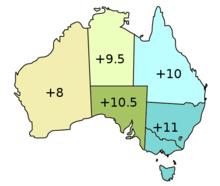
While New South Wales, Victoria, Tasmania, Australian Capital Territory and South Australia adjusted their clocks to daylight saving (adjusting the official local time forward, by one hour) a couple of weeks ago (earlier in Tasmania) we in Queensland together with Western Australia and the Northern Territory have left our clocks untouched.

In a 1992 referendum Queenslanders categorically rejected daylight saving. I am unaware of the specific arguments back then, but based on the discussions in the media this time around they seem to have revolved around beginning the day in darkness, ruining some farmers routines, disruption in sleep patterns and increased temperature at the end of the day.

Queenslanders appear to have the daylight saving discussion annually and this year was no exception with Premier Peter Beattie fronting the peculiar argument that daylight saving would have the consequence of increasing our exposure to the sun, increasing the risk of developing skin cancer (click here for a presentation of the arguments). Funny, he didn't argue for daylight saving as way of conserving power in these climate change times.

The main problem is of course that Queensland is huge in all directions. There is little seasonal variation in the tropical north, while the south has a more temperate and variable climate. For us living in Brisbane (which is the far east) the problem is also exaggerated. Sunrise here is earlier than in the west. Sunrise in summer is very early. It is light before 5am – great if you get up early to work, but not if you want to stay up past 10pm. Sunset is around 6:30pm.

Beattie has promised a vote on the issue next year to see if consensus has changed since 1992. This is a good move. Queensland should have time zones that suit the majority. The problem is that the vote is likely to reveal a very clear geographical preference, with the majority of people in the south east preferring daylight saving and the others the status quo. One way to solve this problem is to split Queensland into two time zones. The southern and eastern part would get the benefits of daylight savings and the northern and eastern parts would retain the existing system.

In any case, for us it is really not a big deal. We live more by the sun than a time zone. Tobias in particular is guided by the sun, although he gets up around 6am at the moment. However, as a consequence of the early sunrise I have shifted my morning routine and now get up at 5am.

There is a fairly detailed Wikipedia entry on daylight saving here and an Australian specific entry here.

Thursday, November 09, 2006

Jellyfish

Tobias har tegnet vand- og brændmænd eller som han ynder at kalde dem jellymans.

Friday, November 03, 2006

Bugs & Frogs

Tobias var helt vild da jeg viste ham billeder af diverse insekter og froeer paa taet hold. Klik her (Click for large gallery of bug close-ups). Hans tre favoritter er nedenfor.


Wednesday, November 01, 2006

3 minutes

Hvis du har tre minutter saa klik her.  Den stoerste prik laver en rotation (en cirkel) paa tre minutter, den naeststoerste prik to rotationer, den tredjestoerste tre....osv.

Sunday, October 29, 2006

Ikea Logan

A new Ikea store opened Friday in a suburb call Logan, 17 km south of Brisbane. In the week leading up to the opening, Ikea spammed the airwaves with an annoying commercial boasting a fictional Swede named Steve (a young bald trendy guy with glasses – thick black frame - dressed in yellow) fine talking the delights of Ikea in Lowgan (i.e. Logan with a Swedish accent).

In Melbourne we often visited Ikea because of their import of Swedish food products not readily available anywhere else. Within the first month of our arrival in Brisbane we decided to keep up the tradition and visit Ikea in Springwood. It turned out to be small and puny and as a result we didn't go again. However, with the new Ikea in Logan we were hoping for a better experience as it was being hailed as the largest Ikea in the Southern hemisphere.


We arrived at 10 to 10. There was already a queue building up outside the car park, but the attendants and police were quick to guide the cars into place. Once inside it was the familiar Ikea layout. On offer was a breakfast consisting of bacon and eggs for a lousy $2, so it wasn’t a surprise that people had turned up early for some food before hitting the exhibition. Because Tobias was hungry we bought some breakfast. It was poor (what can you expect for $2), but Tobias was happy nonetheless.

We ended up spending $120 on different items, most significantly some Christmas decorations. On our way out we also paid the Swedish food market a visit and bought some obligatory liquorish.

I am certain Logan Ikea will be a great success. Located between the Gold Coast and Brisbane it has a huge market base. It also has a reasonable size and therefore the full Ikea range with a decent warehouse to go with it.

Saturday, October 28, 2006

Monicacos de Esperanza

Neil Guy, Burning Man photographer extraordinaire, has posted his striking 2006 pix: http://burningcam.com/2006/photos/.

Above is a photo of Monicacos de Esperanza by Pepe Ozan. An odd ensemble of surreal creatures walking towards nowhere. The creature in the foreground reminds me of cartoonist Vaugh Bodé. A common theme in his works was the use of lizard-like creatures as stand-ins for "real" humans (though most of his female characters are quite human).

Friday, October 27, 2006

Extracting extra value

Many DVDs have alternative language tracks. Especially many of the cartoons we have bought for Tobias contain a multitude of language options. Today Tobias watched the first 20 minutes of Garfield in Finnish by his own request. He had a ball!

Thursday, October 26, 2006

iCrib

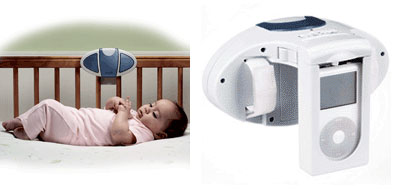
I was clicking my way through the Engadget website and came across the iCrib. Well, I guess it shouldn't come as a surprise that someone would come up with a sound system that attaches an iPod to a crib. After all, babies like music and lots of people own iPods (we have 4), so it makes a whole lot of sense.

Christoffer is too old for the iCrib, he would probably grab it, wrestle it free and proceed to shake it and push any buttons he could find. Ultimately he would probably toss it through the air in an attempt to see how far it could fly. Probably better to consider the iCrib for the next one. And no... before you get too excited there is nothing on the way.